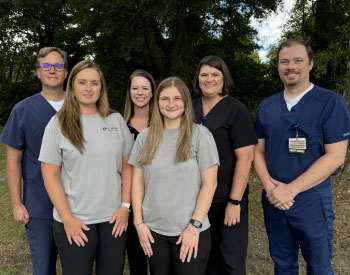
 The ACH Therapy Team.
Therapy Services
Therapy Services for the entire family from pediatrics to geriatrics!
We are experienced and licensed professionals dedicated to providing one on one quality care to get you back to living life to the fullest. Ask your provider for a referral to ACH Therapy Services today!
Physical Therapy
 Tyler Roley, PT DPT, ACH Therapy Manager Tina Wooten, PTA Michael "Shane" Johnson, PTA Ashley Carnley, PTA
Speech Therapy
Nora Morris MS, CCC-SLPOccupational Therapy
Kelly Robbins, OTR/L
Front Office
Kari Ashcraft, Front Office TeamSkylar Sirmon, Front Office Team
Occupational Therapy at Atmore Community Hospital for Pediatrics to Geriatrics
Occupational therapy is the only profession that helps people across the lifespan to do the things they want and need to do through the therapeutic use of daily activities (occupations). Occupational therapy practitioners enable people of all ages to live life to its fullest by helping them promote health, and prevent--or live better with--injury, illness, or disability.
Pediatric Occupational Therapy:
A comprehensive evaluation will be performed and client-centered treatment plans will be developed to help your child reach his or her potential. The therapist will work to prevent, develop, improve, sustain, or restore the child's abilities and skills that allow him or her to perform meaningful daily activities and routines. The therapist will collaborate with families and other medical professionals who work closely with your child to ensure a well-rounded team approach to client care. In addition to helping your child meet his or her fine motor, self-care, and handwriting milestones, the therapist can provide sensory integration therapy, feeding therapy, and visual-motor therapy.
Some common disorders include, but not limited to:
Autism and Related Disorders
Developmental Delay
Attention Deficit Hyperactive Disorder (ADHD)
Cerebral Palsy
Visual Processing Disorders
High Risk Infants
Learning Disorders
Cognitive Impairment
Down Syndrome
Premature Infants
Spina-Bifida
Sensory Integrative Dysfunction
Juvenile Rheumatoid Arthritis
Traumatic Brain Injury
Perceptual and Visual Disorders
Feeding Disorders
Occupational Therapy (OT):
The OT will provide a comprehensive evaluation and establish a client-centered treatment plan for a patient to reach their highest potential. The OT will promote improvement in the patient’s skills and abilities that allow him or her to perform meaningful activities and routines. From self care activities to work related tasks, occupational therapy can implement therapeutic interventions to help get the patient back to independent performance.
Services provided:
Training on adaptive equipment or adaptive techniques
Range of Motion and Strengthening Exercises
Coordination and Sensory training
Scar Management
Edema Management
Pain Management
Soft Tissue and Joint Mobilization
Fitting of splints
Modalities, such as: ultrasound, fluidotherapy, and electrical stimulation
Common injuries and conditions treated include:
Fractures
Tendon and nerve repair
Carpal Tunnel syndrome
Rotator Cuff Repair
Joint Replacement
Stoke
Lymphedema
Physical Therapy at Atmore Community Hospital for Pediatrics to Geriatrics
Physical therapists are movement experts! Whether you’re pediatric or geriatric or somewhere in between, our ultimate goal is to get you moving better. We treat a wide variety of impairments affecting the musculoskeletal and neurological systems from head to toe. We use interventions that are evidence based to provide diversified care to each patient, that is based off your presentation, not just you’re diagnosis. Whether it is difficulty walking, trouble using a joint i.e. (knee, shoulder, neck, back, ankle, or any other), or just having pain, we strive to provide you with the upmost care. Let us work with you in helping improve your quality of life today!
Some common injuries include, but are not limited to:
Vestibular rehab
Vertigo
Concussion
Orthopedic
Back pain
Shoulder pain
Gait disturbances
Plantar fasciitis
Joint replacements
Prehab prior to surgery
Arthritis
Bursitis
Tendonitis
Falls
Balance
Amputations
Core strengthening
Tarsal tunnel
MVA
whiplash
Neurological
MS
Parkinson's
Concussion
Stroke
Guillan Barre
Pain management
Pediatrics
Developmental delay
Cerebral Palsy
Autism
Down syndrome
Torticollis
Delayed Walking
Repetitive use syndromes
Sports Injuries
Patient Reviews:


Speech Therapy
Speech-Language Pathologists (SLPs) work to prevent, assess, diagnose, and treat speech, language, social communication, cognitive-communication, and swallowing disorders in children and adults.
* Speech Disorders
Language Disorders
Augmentative and Alternative Communication (AAC)
Genetic disorders
Autism Spectrum Disorder (ASD)
Articulation and Phonological Disorders
Hearing Impairment
Swallow disorders/Dysphagia
Fiberoptic Endoscopic Evaluation of Swallowing (FEES)
Traumatic Brain Injury
Stroke
Aphasia
Voice DisordersTypes of Disorders:
Speech disorders occur when a person has difficulty producing speech sounds correctly or fluently (e.g., stuttering is a form of disfluency) or has problems with his or her voice or resonance.
Language disorders occur when a person has difficulty understanding others (receptive language), or sharing thoughts, ideas, and feelings (expressive language). Language disorders may be spoken or written and may involve the form (phonology, morphology, syntax), content (semantics), and/or use (pragmatics) of language in functional and socially appropriate ways.
Social communication disorders occur when a person has trouble with the social use of verbal and nonverbal communication. These disorders may include problems:
(a) Communicating for social purposes (e.g., greeting, commenting, asking questions)
(b) Talking in different ways to suit the listener and setting
(c) Following rules for conversation and story-telling
All individuals with Autism Spectrum Disorder (ASD) have social communication difficulties. Social communication disorders are also found in individuals with other conditions, such as Traumatic Brain Injury (TBI).
Cognitive-communication disorders include problems with organizing thoughts, paying attention, remembering, planning, and/or problem solving. These disorders usually happen as a result of a stroke, traumatic brain injury, or dementia, although they can be congenital.
Swallowing disorders (dysphagia) are feeding and swallowing difficulties, which may follow an illness, surgery, stroke, or injury.